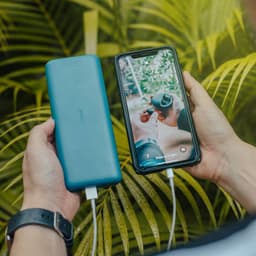
Power Bank
A flight-approved portable battery that charges laptops, phones, and tablets. Essential gear for working anywhere.
What is a Travel Power Bank?
A travel power bank is a portable battery that recharges your devices without an outlet. Modern high-capacity power banks can charge laptops, phones, tablets, and other USB devices multiple times before needing a recharge themselves.
For digital nomads, a good power bank is not optional gear. It is the difference between a productive work session and hunting for outlets in every cafe.
Our Top Picks for 2026
These three models cover almost every nomad use case. All are under the 100Wh airline limit, so they fly carry-on with no special approval.
| Pick | Capacity | Max Output | Ports | Flight Status |
|---|---|---|---|---|
| Anker 737 (PowerCore 24K) — best overall | 24,000mAh (86.4Wh) | 140W USB-C | 2× USB-C, 1× USB-A | ✅ Carry-on approved |
| UGREEN 145W 25,000mAh — best value | 25,000mAh (90Wh) | 145W total | 2× USB-C, 1× USB-A | ✅ Carry-on approved |
| Anker Prime 250W — best for multi-device | 27,650mAh (~99.5Wh) | 250W total (140W per port) | 2× USB-C, 1× USB-A | ✅ Carry-on approved (just under 100Wh) |
Anker 737 Power Bank (PowerCore 24K) — the default recommendation. 140W output charges a MacBook Pro at nearly full speed, the smart display shows exact percentage and time remaining, and it recharges itself fast at up to 140W input.
UGREEN 145W 25,000mAh — the strongest competitor to the Anker 737, usually at a noticeably lower price. Slightly more capacity, three ports, and enough output for any USB-C laptop.
Anker Prime 27,650mAh (250W) — for content creators and multi-device setups. It can push 140W to a laptop and still fast-charge a phone and camera at the same time, and it sits just under the 100Wh airline ceiling.
Why Power Banks Are Essential for Nomads
Work Without Outlet Anxiety
Many cafes have limited outlets, often in inconvenient locations. Coworking spaces fill up. Airports charge premiums for seats near power. A power bank frees you from these constraints.
Set up wherever the WiFi is good, the coffee is fresh, or the view is inspiring. Your power comes with you.
Backup During Outages
In many countries, power outages are common. A charged power bank means you can keep working, or at least keep your phone alive to communicate and navigate.
Long Travel Days
Flights, layovers, buses, and trains add up. A single phone charge might not survive a 20-hour travel day. A power bank ensures you arrive with working devices.
Remote Locations
Beaches, parks, rooftops, and outdoor terraces rarely have outlets. A power bank extends your workspace to anywhere with WiFi or mobile data.
Understanding Power Bank Specs
Capacity (mAh)
Milliamp-hours measure total battery capacity. Higher numbers mean more charges.
| Capacity | Phone Charges | Laptop Charges |
|---|---|---|
| 10,000mAh | 2-3 | 0.3 |
| 20,000mAh | 5-6 | 0.7 |
| 26,800mAh | 7-8 | 1.0 |
Note: Actual performance is about 70% of rated capacity due to conversion losses.
Watt-Hours (Wh) and Flight Rules
Airlines measure in watt-hours, not mAh. The formula: Wh = mAh × V / 1000
- Under 100Wh: Allowed on all flights (carry-on only)
- 100-160Wh: Allowed with airline approval
- Over 160Wh: Prohibited on commercial flights
A 26,800mAh power bank at 3.7V equals approximately 99Wh, just under the limit.
Power Delivery (PD)
USB-C Power Delivery determines charging speed. For laptops:
| Output | Best For |
|---|---|
| 30W | Phones, tablets |
| 45W | Light ultrabooks |
| 60W | Most laptops |
| 100W | Power-hungry laptops |
Check your laptop's charging requirements. Most USB-C laptops work with 60W or higher.
How to Choose a Power Bank
For Phone-Only Users
A 10,000-15,000mAh power bank is sufficient. Prioritize compact size and fast charging. Look for 20W+ output.
For Laptop Workers
Choose 20,000-26,800mAh with 60W+ USB-C PD output. This handles most laptops and provides multiple phone charges. Stay under 100Wh for hassle-free flying.
For Content Creators
Consider multiple power banks or the highest capacity allowed. Camera batteries, drones, and editing on laptops drain power quickly. Look for models with multiple high-power outputs.
Top Features for Travel
Multiple Ports
Charge your laptop, phone, and earbuds simultaneously. Look for at least one USB-C PD port and one or two USB-A ports.
Pass-Through Charging
Charge the power bank while it charges your devices. Useful when outlets are available but limited.
Built-In Cables
Eliminates carrying extra cables. Some models include USB-C, Lightning, and micro-USB built in.
LED Display
Shows remaining capacity accurately. Four LED dots are less precise than a percentage display.
Compact Design
Travel-friendly power banks balance capacity with portability. Check weight and dimensions, not just mAh.
Using Your Power Bank Effectively
Pre-Trip Preparation
Fully charge your power bank the night before travel. A half-charged power bank defeats the purpose.
Strategic Charging
Charge your most important device first. If power runs low unexpectedly, you want your phone at 100%, not three devices at 50%.
Temperature Awareness
Power banks perform worse in extreme temperatures. Keep them insulated in cold weather and out of direct sun in heat.
Regular Cycling
Use and recharge your power bank regularly, even if not traveling. Batteries degrade faster when stored at full or empty charge for long periods.
Power Bank Comparison
| Feature | Budget (~$40) | Mid-Range (~$80) | Premium (~$150) |
|---|---|---|---|
| Capacity | 20,000mAh | 25,000mAh | 26,800mAh |
| Laptop Charging | Basic (30W) | Standard (60W) | Fast (100W) |
| Build Quality | Plastic | Aluminum | Premium materials |
| Ports | 2-3 | 3-4 | 4+ with smart routing |
| Weight | Heavier | Moderate | Optimized |
Recommended Brands
Trusted power bank manufacturers for travel:
- Anker: Reliable across every price tier, excellent customer service
- UGREEN: Strong value with high-wattage laptop charging
- Zendure: Premium build quality, innovative features
- Baseus: Affordable with solid performance
- INIU: Budget-friendly compact options for phone-first users
Avoid unknown brands with suspiciously low prices. Battery quality matters for safety and longevity.
Common Mistakes
Buying too small: A 5,000mAh power bank will not save you. Go bigger than you think you need.
Ignoring output wattage: High capacity means nothing if output cannot charge your laptop.
Checking power banks: Airlines prohibit power banks in checked luggage. Always carry on.
Forgetting to charge: A dead power bank is dead weight. Develop a charging routine.
The Bottom Line
A quality power bank extends your working day and eliminates outlet anxiety. For digital nomads, this is not a nice-to-have accessory. It is essential infrastructure for location-independent work.
Invest in a 20,000mAh+ power bank with 60W USB-C PD output. Keep it charged. Carry it always. You will use it more than almost any other travel gear you own.
Pros
- Work from anywhere without outlet hunting
- Extend laptop battery life by hours
- Charge multiple devices at once
- Flight-approved sizes available
- Essential backup during power outages
Cons
- Adds weight to your travel kit
- Larger capacity means longer recharge time
- Some airlines have strict carry-on rules
- Quality varies dramatically by brand
Category
Frequently Asked Questions
Can I bring a power bank on a plane?
What capacity power bank do I need for a laptop?
How long does it take to recharge a large power bank?
Should I get built-in cables or separate cables?
Pricing
$50-150
Key Features
- High-capacity battery (20,000-26,800mAh)
- Laptop charging via USB-C PD
- Multiple device charging simultaneously
- Flight-approved under 100Wh
- Pass-through charging
- Fast charging support
Available Regions
Global

